
Special shapes double glazing
Arched heads, fanlights, curved bays and Gothic lights: vacuum units made to template, fitted into the original frames.
Request a quote
Special shape double glazing use cases
We call "special shapes" all double glazing units that do not have a classic rectangular shape: curved, fully curved, trapezoid, oval, segmental or pointed. Modern vacuum glazing manufacturers can produce them, which matters because the shaped panes — the arched head of a Georgian sash, the fanlight over a front door, the curved glass of a bow window — are usually the most characterful part of a period elevation and the first thing lost when a window is replaced.
In practice the shapes fall into a few families:
- Arched and segmental heads on sashes and casements, common on Victorian and Gothic Revival houses, chapels and schools.
- Fanlights over front doors, semi-circular or elliptical, often with radiating bars — each segment is a separate small unit.
- Curved (bent) glass in bow windows and curved bays, where the pane itself follows the radius of the wall.
- Trapezoids and triangles in gables, dormers and staircase windows.
- Circles and ovals — oeil-de-boeuf windows and porthole lights.

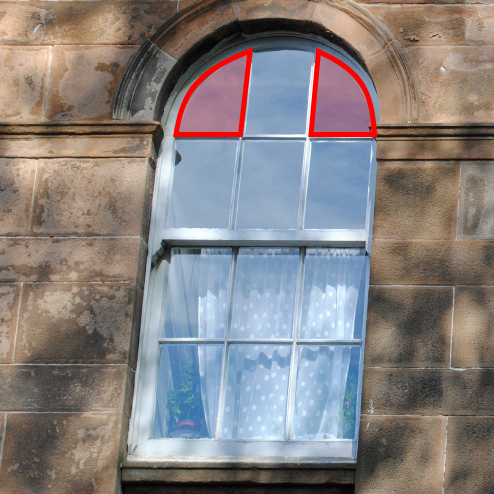
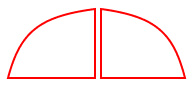
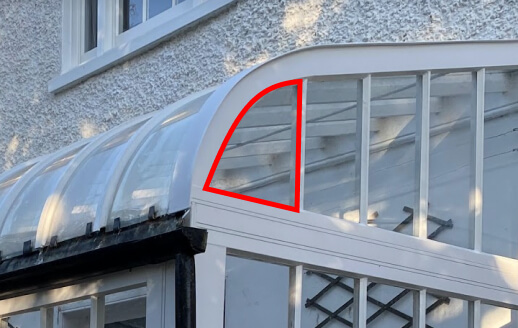
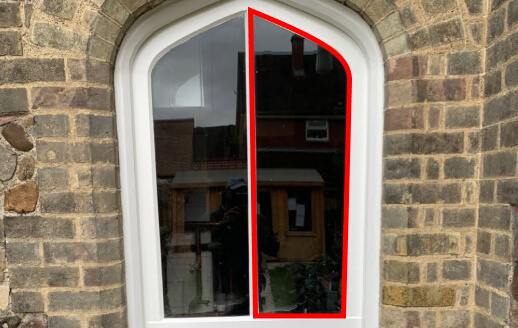
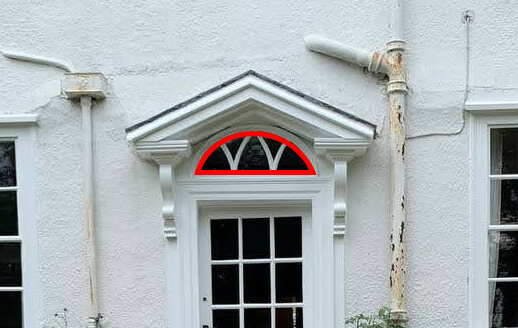
Available special shapes
With special shapes, the work follows the same steps as a regular unit
Precise measurements — and for anything curved, a template — are taken of the glazing in each sash and the glass is ordered. When the units arrive, the frames are worked on much as they would be for a rectangular window, except that shaped router guides are used more often. The glazed opening, once the unit has been fitted and wedged into its new rebate, is kept strictly identical to the original.
As with every window, the result is a frame restored to its original state with the performance of modern double glazing, and insulating seals around all the edges.
Measuring and templates
Why a template, not just dimensions
Old arched sashes are rarely true arcs, and no two fanlights on a terrace are quite the same. A rigid template taken from the actual rebate — or a full-size tracing for a curved head — is what the factory cuts to, so the unit drops into the opening without forcing and the putty line stays even. Templates are taken at the survey or, for occupied rooms, on the morning of the job before the sash goes to the bench.
Glazing bars in shaped heads
Where an arched head has radiating or curved bars, each segment becomes its own small unit. The bars are kept; the rebates behind them are deepened like any other, and the segments are puttied individually. It is slower than a single pane, which is why bars are the main driver of cost on shaped work.
Curved glass
Bent vacuum units for bow windows are made to the radius of a template of the existing pane. Because the glass is formed before the unit is assembled, lead times can run longer than the usual four to six weeks; the survey confirms the programme before anything is ordered.
Doors and fixed lights
Fanlights and fixed shaped lights are the simplest special-shape jobs: nothing has to slide afterwards, so the extra weight of the unit needs no counterbalancing. Glazed doors are different — glass beside or in a door usually has to be safety glazing, which is discussed at the survey rather than assumed.
FAQ
Is special shape double glazing more expensive?
Yes, somewhat. A curved or arched unit takes a template, more handling at the factory and more time on the bench, so it costs more than a rectangle of the same area. It is priced per unit at the survey; the rest of the window is priced exactly as a rectangular one.
How do you install special shape double glazing into the original frame?
With the same process as a rectangular pane: the sash comes out, the rebate is deepened — with router guides made for the curve — the unit is bedded, wedged and puttied, and the sash goes back. The glazed area is kept strictly identical to the original.
What is the smallest unit that can be made?
The manufacturer’s minimum is 200 mm × 200 mm. Very small panes in Georgian bars are usually fine; the survey confirms each one.
Can a fanlight over a front door be done?
Yes. Semi-circular and segmental fanlights, with or without radiating bars, are templated in the same way as an arched sash head. Fixed lights are the simplest case because nothing has to slide afterwards.
What about curved glass in a bow window?
Curved (bent) vacuum units are made for bow windows and curved bays. The radius is taken from a template of the existing pane. Lead times can be longer than for flat special shapes, which the survey visit will confirm.
Send a photo of the window
For shaped work a photograph from outside, straight on, is the most useful thing you can send with the enquiry — it shows the shape, the bars and the condition in one go.